
Organizational Management-Chapter 15: Understanding Groups and Teams

Chapter 15: Understanding Groups and Teams
This chapter explores the fundamental concepts of groups and teams, their stages of development, the factors that influence their effectiveness, and the crucial role managers play in building and managing high-performing collaborative units.
1. What is a Group? Why are Groups Important?
Definition of a Group: Two or more interacting and interdependent individuals who come together to achieve specific objectives. Groups can be formal (established by the organization) or informal (formed naturally by members).
Formal Groups: Command groups (determined by the organizational chart, e.g., a department), Task groups (formed to complete a specific task, e.g., a project team).
Informal Groups: Friendship groups (common interests, e.g., employees who carpool), Interest groups (come together for a specific objective, e.g., employees advocating for a new cafeteria).
Why Managers Care About Groups:
Performance: Groups can perform tasks an individual cannot.
Problem Solving: Diverse perspectives can lead to better decisions.
Employee Satisfaction: Fulfills social needs (Maslow, Chapter 12).
Learning: Members learn from each other.
Dissemination of Information: Groups are channels for communication.
Influence Behavior: Group norms can influence individual behavior.
2. Stages of Group Development
Groups typically go through a predictable sequence of stages, though not all groups progress through them at the same pace or in the same order.
Forming Stage:
Characteristics: Uncertainty about purpose, structure, and leadership. Members test the waters to determine acceptable behavior.
Manager's Role: Provide clear direction, establish ground rules, facilitate introductions.
Storming Stage:
Characteristics: Intragroup conflict as members resist the control of the group and leadership. Personalities clash, and power struggles emerge.
Manager's Role: Encourage open communication, mediate conflicts, reinforce group purpose, ensure psychological safety.
Norming Stage:
Characteristics: Group cohesion and close relationships develop. A sense of group identity emerges, and norms (rules of behavior) are established.
Manager's Role: Solidify group structure, reinforce positive norms, clarify roles and responsibilities.
Performing Stage:
Characteristics: The group is fully functional and focused on achieving its goals. Energy shifts from getting to know each other and resolving conflict to performing the task.
Manager's Role: Delegate, empower, support, provide resources, celebrate successes.
Adjourning Stage:
Characteristics: For temporary groups (task forces, project teams), this is the stage of wrapping up activities and preparing for dissolution.
Manager's Role: Recognize achievements, provide closure, facilitate individual transitions.
3. Group Structure
The internal framework of a group affects how its members behave and perform.
A. Roles:
Definition: A set of expected behavior patterns attributed to someone occupying a given position in a social unit.
Role Conflict: When an individual is confronted by divergent role expectations.
Role Ambiguity: When a person is unclear about the expectations of a role.
Role Overload: When too much is expected of someone.
B. Norms:
Definition: Acceptable standards of behavior shared by group members. They tell members what they ought and ought not to do under certain circumstances.
Common Norms: Performance norms (effort, quality), appearance norms, social arrangement norms, resource allocation norms.
Impact: Norms can be powerful influences on individual behavior, often more so than formal rules.
Conformity: Adjusting one's behavior to align with the norms of the group. (Asch experiments showed strong pressure to conform).
C. Status:
Definition: A socially defined position or rank given to groups or group members by others.
Sources of Status: Education, age, skill, experience, organizational position.
Impact: High-status members often have more freedom to deviate from norms, are more assertive, and have more influence. Status inequities can lead to resentment and conflict.
D. Group Size:
Small Groups (2-7 members): Faster at completing tasks, more productive (typically), but less diverse input.
Large Groups (12+ members): Better for gaining diverse input, but slower at task completion, prone to social loafing.
Social Loafing: The tendency for individuals to expend less effort when working collectively than when working individually.
Mitigation: Set clear individual accountability, make individual contributions identifiable, emphasize importance of individual contributions.
E. Cohesiveness:
Definition: The degree to which group members are attracted to each other and are motivated to stay in the group.
Factors Increasing Cohesiveness: Small size, external threats, shared goals, time spent together, past success.
Relationship to Productivity: High cohesiveness and high alignment with organizational goals leads to high productivity. If group goals oppose organizational goals, high cohesiveness can lead to lower productivity.
4. Group Processes
How groups interact and work together.
A. Group Decision Making:
Advantages (revisit from Chapter 7): More complete information and knowledge, more alternatives, increased acceptance of a solution, increased legitimacy.
Disadvantages (revisit from Chapter 7): Time-consuming, minority domination, pressure to conform (Groupthink), ambiguous responsibility.
Groupthink: A phenomenon in which the desire for harmony or conformity in the group results in an irrational or dysfunctional decision-making outcome.
Symptoms: Illusion of invulnerability, rationalizing resistance, belief in inherent morality of the group, stereotyping outsiders, direct pressure on dissenters, self-censorship, illusion of unanimity, mindguards.
Prevention: Encourage critical evaluation, assign a devil's advocate, obtain external opinions, break into subgroups, leaders avoid stating preferences early.
B. Conflict Management:
Definition of Conflict: A process that begins when one party perceives that another party has negatively affected, or is about to negatively affect, something that the first party cares about.
Functional vs. Dysfunctional Conflict:
Functional (Constructive): Supports the goals of the group and improves its performance (e.g., healthy debate over ideas).
Dysfunctional (Destructive): Hinders group performance (e.g., personality clashes, threats).
Sources of Conflict: Communication breakdown, structural differences (size, specialization), personal variables (personality, values), competition for resources.
Conflict Resolution Strategies: Avoidance, accommodation, forcing, compromise, collaboration. Managers must choose the appropriate strategy based on the situation.
5. From Groups to Effective Teams
While all teams are groups, not all groups are teams. Teams have characteristics that elevate them beyond simple groups.
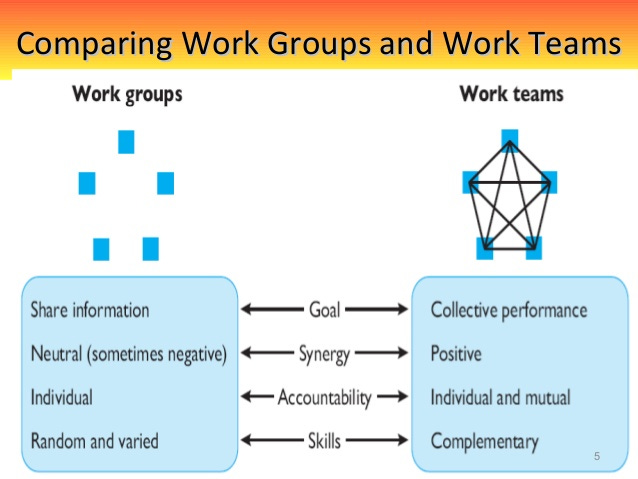
Definition of a Work Team: A group whose members work intensely on a specific, common goal using their positive synergy, individual and mutual accountability, and complementary skills.
Synergy: The concept that the whole is greater than the sum of its parts (2+2=5). Teams aim for positive synergy.
Differences Between Groups and Teams:
Group: Share information, neutral synergy, individual accountability, random and varied skills.
Team: Collective performance, positive synergy, individual AND mutual accountability, complementary skills.
Types of Work Teams:
Problem-Solving Teams: Members from the same department who meet regularly to discuss quality, efficiency, and work environment problems.
Self-Managed Work Teams: Groups of employees who operate without a manager and are responsible for a complete work process or segment. They plan, schedule, assign tasks, make operating decisions, and take collective responsibility for results. (Requires high autonomy, empowerment).
Cross-Functional Teams: Employees from about the same hierarchical level, but from different work areas, who come together to accomplish a task. (e.g., a new product development team).
Virtual Teams: Teams that use computer technology to tie together physically dispersed members in order to achieve a common goal. (Revisit Chapter 14 communication challenges).
6. Characteristics of Effective Teams
What makes a team perform well?
Clear Goals: A shared understanding of the team's purpose and direction.
Relevant Skills: Members possess the necessary technical and interpersonal skills.
Mutual Trust: Members believe in each other's integrity, character, and ability.
Unified Commitment: Dedication to the team's goals, even at the expense of individual goals.
Good Communication: Open, honest, and effective information flow (Chapter 14).
Negotiating Skills: Ability to address and resolve conflicts constructively.
Appropriate Leadership: Leaders who can inspire, guide, and support (Chapter 13).
Internal and External Support: Proper resources, training, and a supportive organizational climate.
7. Manager's Role in Building and Managing Teams
Leading Teams: Requires different skills than leading individuals. Often involves coaching, facilitating, empowering, and being a role model. (Links to contemporary leadership styles, Chapter 13).
Building Team Cohesion and Trust: Encourage social interaction, celebrate successes, provide opportunities for shared experiences.
Managing Conflict: Facilitate healthy debate, mediate disputes, ensure focus remains on tasks, not personal attacks.
Performance Evaluation and Rewards: Shift from purely individual performance to rewarding both individual and team contributions to foster collaboration.
Decision Making: Choose appropriate decision-making approaches (e.g., consensus, majority vote) and facilitate productive discussions.
Addressing Social Loafing: Ensure individual accountability and clear roles.
Team Training: Provide training in communication, conflict resolution, problem-solving, and specific technical skills needed by the team.
Chapter 15 provides a comprehensive understanding of group dynamics and the powerful potential of effective teams. It moves beyond simply putting people together to explaining how to cultivate true synergy and collective high performance. For modern managers, the ability to build, nurture, and lead successful teams is an indispensable skill. This chapter directly links to topics of organizational design, motivation, leadership, and communication, integrating many concepts we've covered previously.